


Regional Homeowner Guidance
Choose Your Region for Homeowner Painting Guidance
Choose your region for homeowner painting guidance that connects seven practical decision guides with the conditions homeowners may encounter across Connecticut and Westchester County, NY. County context helps you ask better questions, while the actual property, surface, exposure and address still determine the written scope.
Choose your county
Start With the Home, Then Add Regional Context
Across all six service regions, we begin with the actual surfaces, visible condition, exposure, access and occupied-home needs. Regional context helps organize questions about shoreline air, wooded shade, older materials, dense access and seasonal weather without replacing a property-specific review.
Guide lens: Use the seven homeowner guides below as a universal decision base, then select a county when location-specific conditions may change the questions you ask.
Questions to bring forward
- Which surfaces and components belong in the scope?
- What exposure, access or occupancy conditions affect preparation?
- Which assumptions still need to be verified at the address?
Shoreline and Inland Homes Need Different Questions
We distinguish shoreline and inland exposure, older and newer finishes, wooded shade, drainage, access and occupied-home logistics before defining preparation.
Guide lens: Give added attention to exposure, drainage, access and protection around occupied or closely spaced homes.
Conditions to verify
- Shoreline air, wind and weather-facing elevations.
- Wooded shade, drainage and recurring moisture.
- Occupied-home access and neighborhood constraints.
Older Materials and Wooded Settings Shape Preparation
We review older wood and plaster, wooded or elevated settings, detached structures, seasonal access and moisture paths without assuming every property shares them.
Guide lens: Prioritize substrate history, seasonal access, wooded moisture and the condition of detached structures.
Conditions to verify
- Older wood, plaster and earlier coating layers.
- Shade, elevation, drainage and seasonal access.
- Detached buildings and less-visible elevations.
Mixed Settings Require Building-Specific Planning
We separate shoreline, urban and suburban conditions while accounting for mixed substrates, occupied spaces, close access and building-specific protection needs.
Guide lens: Compare substrate changes, close access, occupied-space protection and the exposure of each elevation.
Conditions to verify
- Shoreline, urban or suburban exposure verified at the address.
- Material transitions, circulation, close access and occupied-space protection.
- Wood, masonry and mixed substrates reviewed for the actual condition.
Housing Form and Daily Circulation Affect the Plan
We account for urban, suburban and river-valley settings, varied housing forms, daily circulation, access and room-by-room sequencing in occupied homes.
Guide lens: Focus on housing form, occupied-home sequencing, access and how work areas connect to daily circulation.
Conditions to verify
- Urban, suburban or river-valley setting.
- Room-by-room access and family circulation.
- Varied housing forms and surface transitions.
Coastal Context Must Be Verified at the Property
We distinguish shoreline, river-adjacent and inland properties, checking actual wind, moisture, drainage, weathered wood and deck exposure instead of applying one coastal formula.
Guide lens: Review wind, moisture paths, weathered wood, decks and drainage rather than assuming every address has the same coastal exposure.
Conditions to verify
- Shoreline, river-adjacent or inland location.
- Wind-facing elevations and recurring moisture.
- Weathered wood, decks and drainage patterns.
Architecture, Density and Exposure Vary Across the County
We separate Sound Shore, Hudson-facing, denser southern and wooded inland settings while reviewing architecture, access, occupied-home protection and property-specific requirements.
Guide lens: Compare architecture, access, density, wooded exposure and occupied-home protection before selecting preparation or finish direction.
Conditions to verify
- Sound Shore, Hudson-facing or wooded inland setting.
- Architecture, surface transitions and home age.
- Access, density and occupied-home protection.

Two states, one climate pattern, many building eras
Across Connecticut and Westchester County, homes share a humid continental climate with freeze-thaw winters and humid summers, but exposure and building era change street by street. The starting point is the individual property, not the town average.
Architecture and housing
- Shoreline, river valley, hill and wooded settings within short distances
- Colonial and Victorian stock alongside post-war and recent construction
- Wood clapboard, cedar shingle, stucco, brick and manufactured siding in the same neighborhood
Climate and exposure
- Freeze-thaw cycling every winter across the whole service area
- Humid summers can affect drying, recoat and cure windows
- Weather narrows workable exterior conditions; manufacturer requirements, surface temperature, moisture and the forecast determine the actual work window.
What this changes
- Two homes on the same street can need different preparation
- Elevation, orientation and shade matter more than the town name
- Scope should be confirmed by address, not by regional assumption
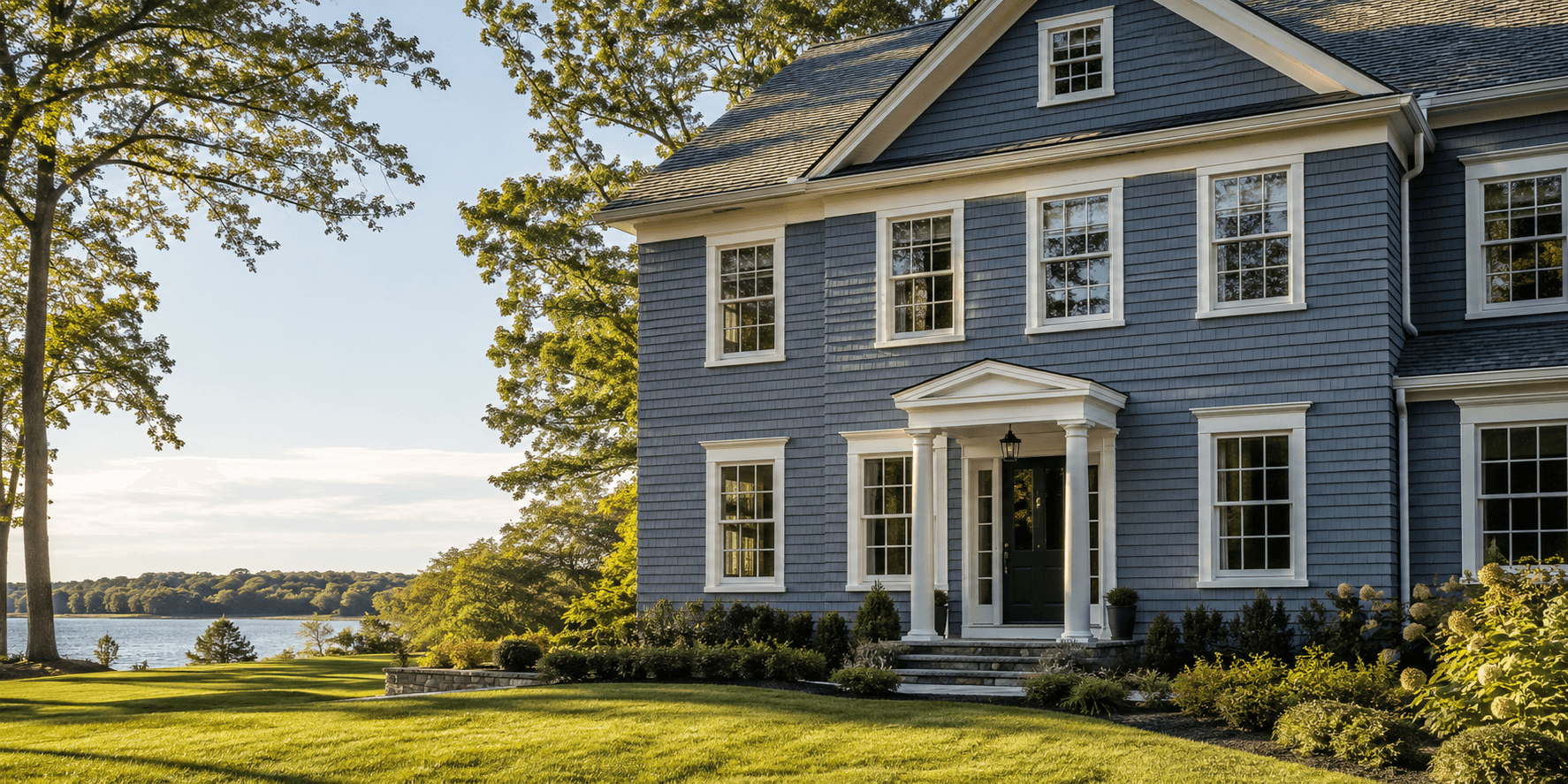
Long Island Sound exposure meets sheltered inland pockets
Fairfield County runs from the Long Island Sound shoreline to wooded inland towns. Salt-laden air and wind-driven rain reach shoreline elevations directly, while inland properties trade salt exposure for heavier tree shade and moisture retention.
Architecture and housing
- Shoreline towns with colonial, shingle-style and clapboard stock
- Inland areas mixing mid-century homes with recent construction
- Painted wood trim, cedar shingle and mixed siding across both settings
Climate and exposure
- Direct Long Island Sound exposure on southern elevations
- Salt-laden air and wind-driven rain on the most exposed faces
- Sheltered inland pockets with dense canopy and slower drying
What this changes
- The elevations receiving the strongest sun, wind or moisture exposure may weather before sheltered faces.
- Salt may influence washing, priming and coating selection when the address and elevation have direct shoreline exposure.
- Exposure can change sharply within a single town
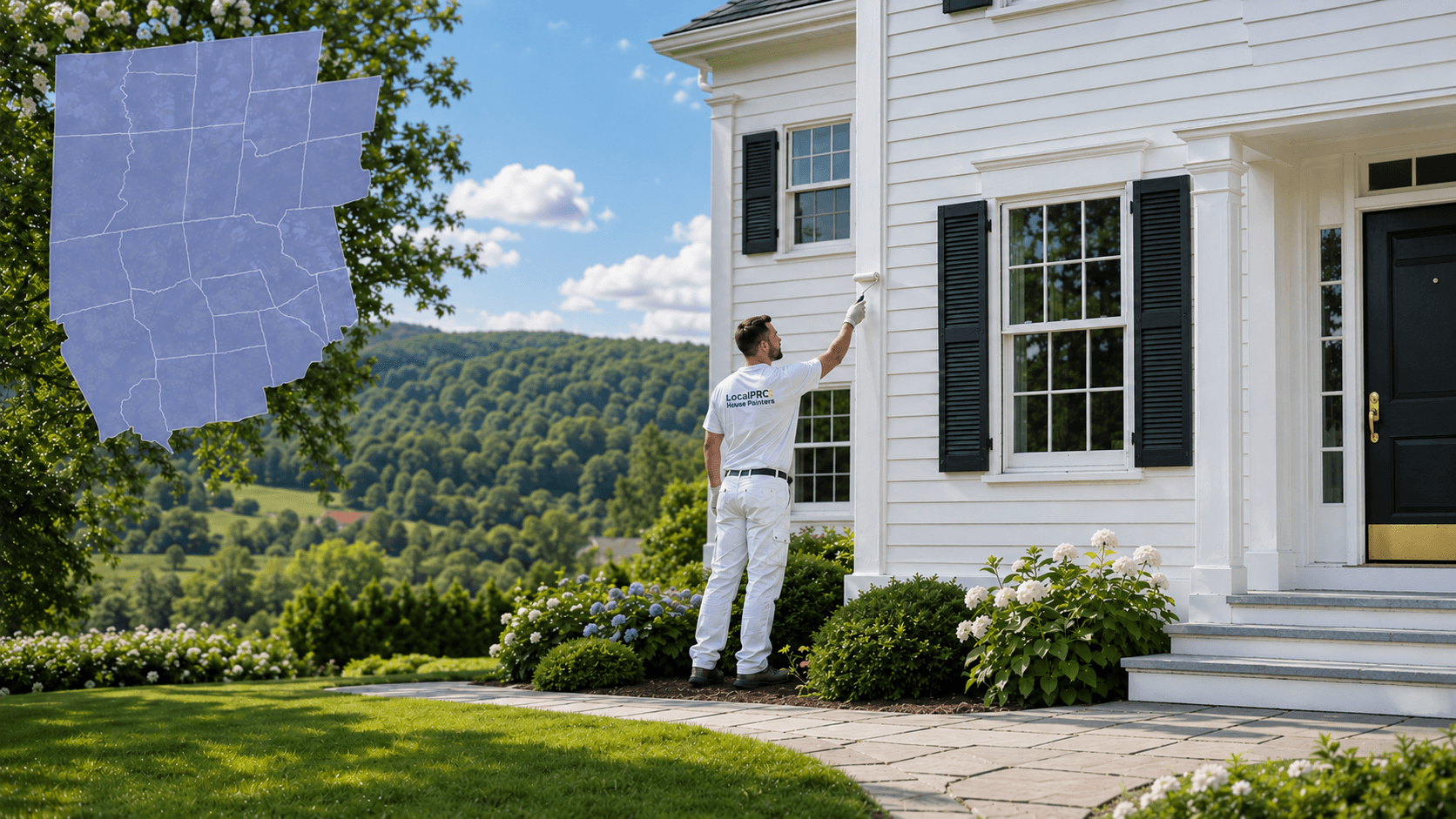
Northwest hills, historic centers and narrower exterior weather windows
Litchfield County covers Connecticut's northwest hills, including the state's highest elevations. Colder temperatures, a longer snow season and heavily wooded lots compress the exterior painting window and put older painted wood under more stress.
Architecture and housing
- Historic town centers with 18th and 19th century clapboard and trim
- Detached barns, outbuildings and porches alongside the main house
- Older painted wood carrying many previous coating layers
Climate and exposure
- Higher elevations with colder winters and a longer snow season
- Repeated freeze-thaw exposure at higher elevations.
- Wooded lots that hold shade and moisture well into the day
What this changes
- A shorter exterior window makes scheduling part of the scope
- Shade and retained moisture favor mildew and organic staining
- Older layered coatings make preparation discovery essential
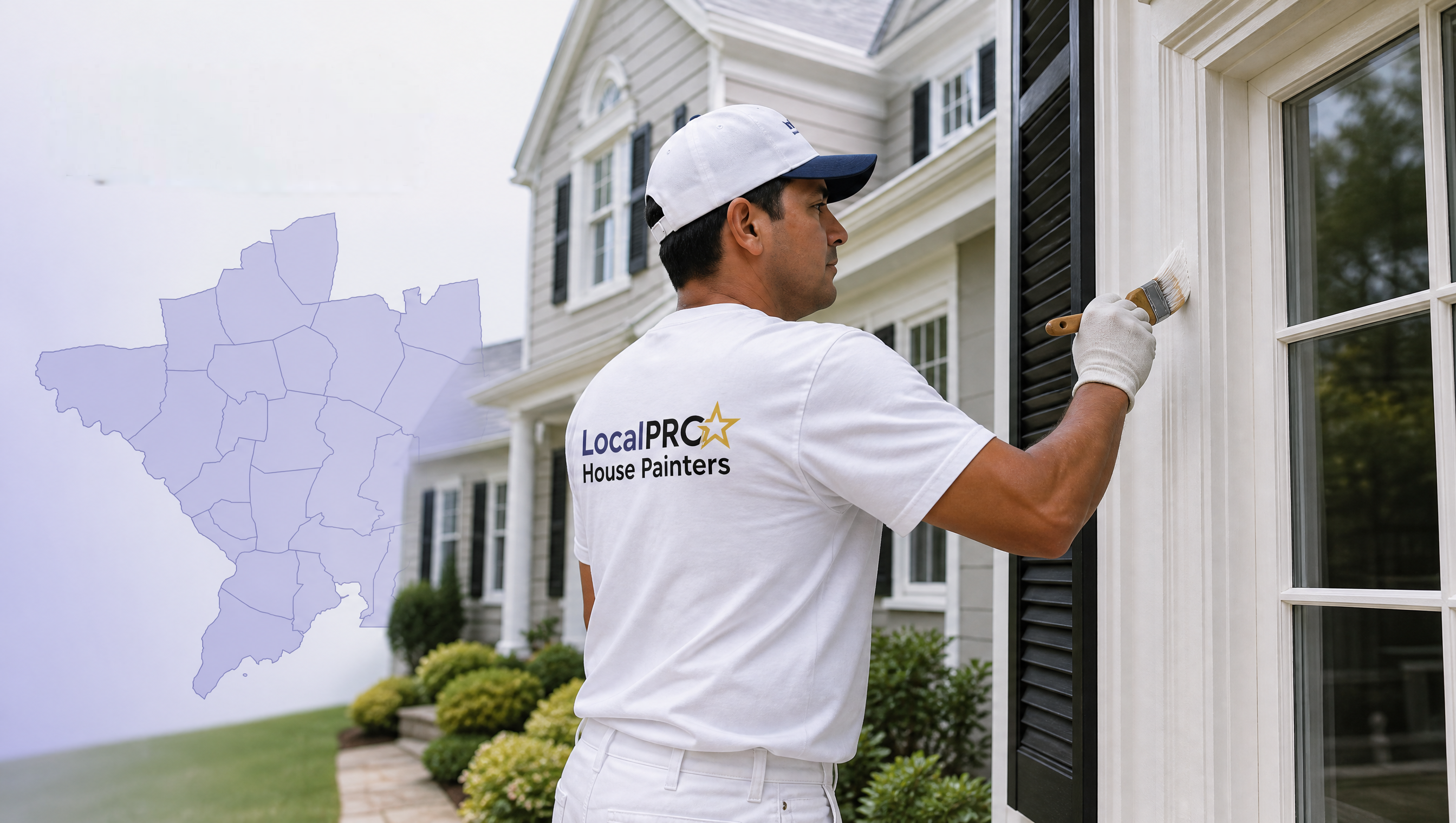
Shoreline towns and dense industrial-era neighborhoods
New Haven County pairs Sound shoreline communities with dense urban and industrial-era housing inland. The result is a wide substrate range, from coastal painted wood to masonry and multi-family buildings where access and occupancy shape the plan.
Architecture and housing
- Shoreline communities with older coastal stock
- Urban and industrial-era neighborhoods with Victorian and multi-family buildings
- Painted masonry and mixed substrates alongside traditional wood
Climate and exposure
- Coastal exposure may influence shoreline addresses when verified
- Proximity, access and occupant circulation vary by property
- Wood, masonry and mixed substrates require condition-specific review
What this changes
- Multi-family and occupied buildings change access and sequencing
- Masonry and wood on the same property may require different specifications
- Shoreline, urban and suburban conditions should be verified at the address
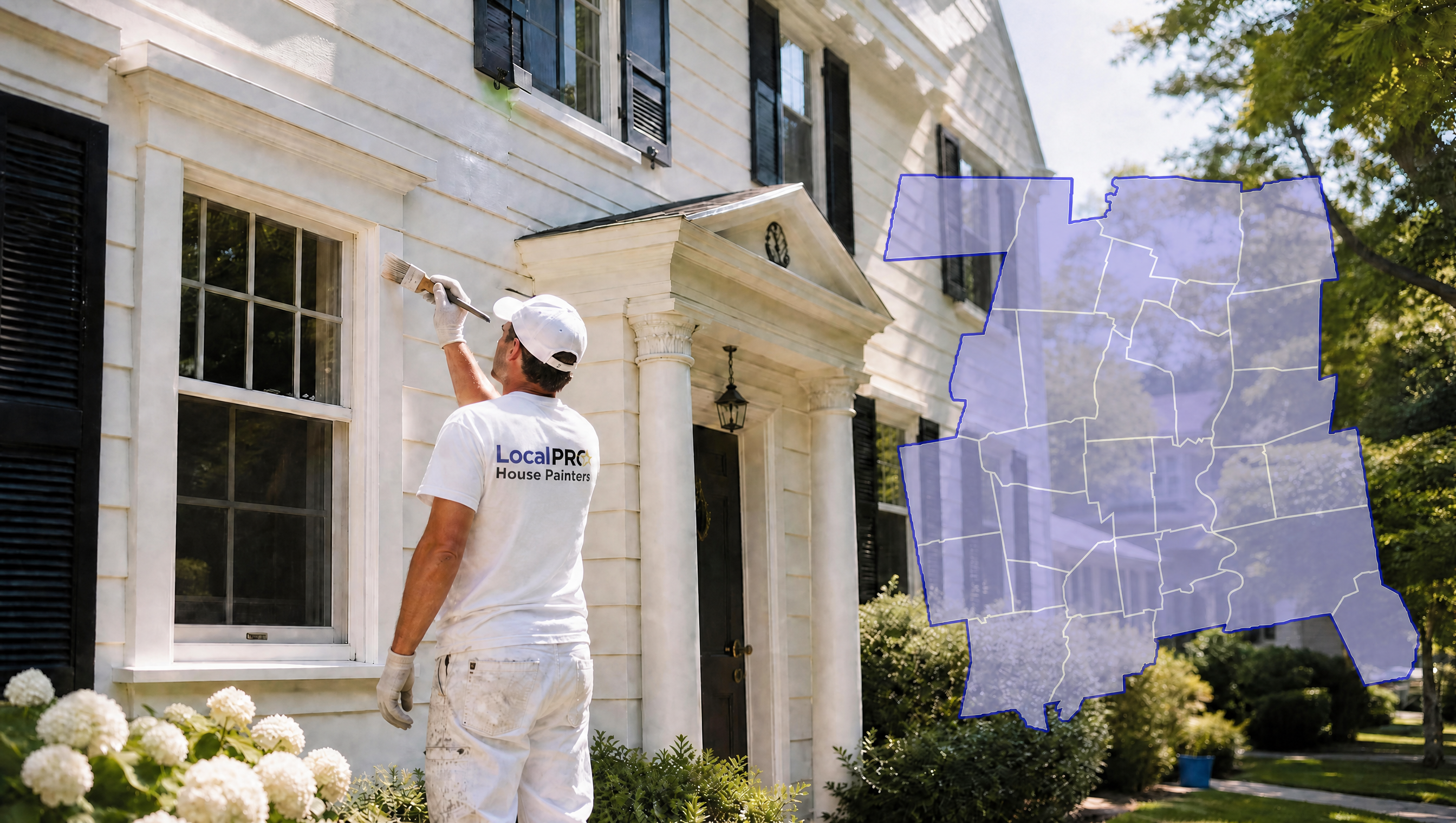
Connecticut River valley with a broad mix of substrates and building eras
Hartford County sits inland in the Connecticut River valley. Without coastal salt, the dominant variables become thermal cycling, summer humidity and an unusually wide mix of siding materials from colonial cores through post-war suburban expansion.
Architecture and housing
- Colonial town cores alongside extensive post-war suburban development
- Wood, painted brick, aluminum and manufactured siding in the same area
- Additions and renovations creating material transitions on one elevation
Climate and exposure
- Inland seasonal temperature variation, humid summers and winter freeze-thaw.
- Humid summers can affect drying, recoat and cure windows
- Exposure and drainage still vary by address
What this changes
- Substrate identification drives product choice more than location
- Material transitions on one wall may need different preparation
- Summer humidity affects recoat timing and final cure

Southeastern shoreline, river mouths and historic districts
New London County meets the Sound along Connecticut's southeastern shoreline and the Thames River. Salt air, marine humidity and periodic fog may affect exposed elevations, while historic maritime settings add address-specific appearance considerations to the technical ones.
Architecture and housing
- Historic maritime districts with older painted wood
- Coastal cottages alongside newer inland development
- Porches, railings and exterior wood details with direct exposure
Climate and exposure
- Direct coastal exposure with salt air, marine humidity and periodic fog
- Humidity can slow drying on shaded elevations
- Storm-driven rain may affect the most exposed faces
What this changes
- Exposed elevations may need attention before the rest of the home
- Salt and moisture influence washing and priming decisions when verified
- When a property falls within a regulated historic district, color or exterior-finish review may apply and should be verified for the address.
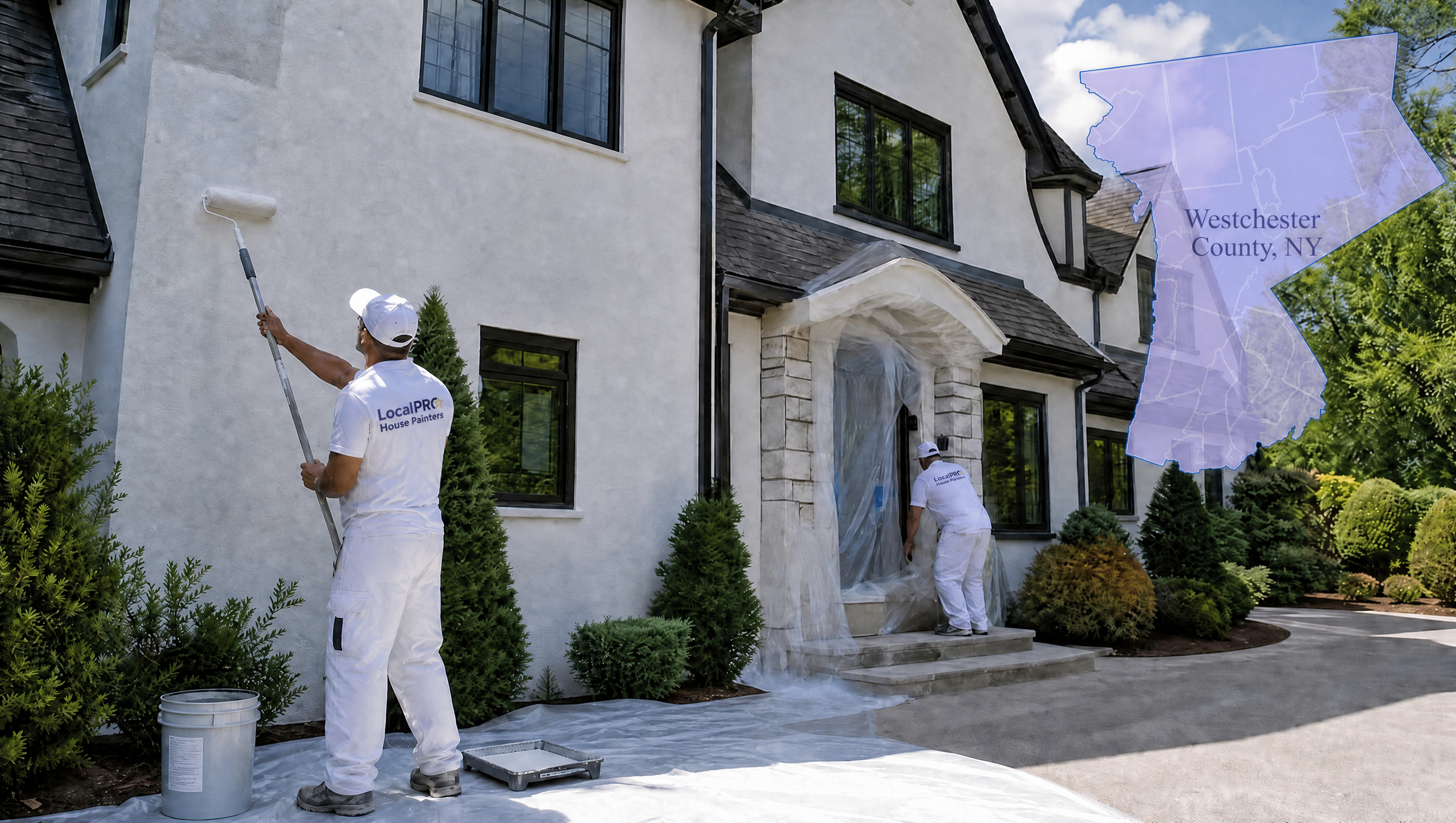
A broad architectural range across Sound Shore, Hudson River, wooded inland and denser southern settings.
Westchester County spans Hudson River communities, Sound Shore towns, wooded northern properties and dense urban centers. That range means no single specification travels well, and mature tree canopy adds a moisture and staining variable across much of the county.
Architecture and housing
- Tudor, colonial revival and stucco alongside cedar and painted trim
- Wooded northern properties, Sound Shore homes and urban buildings
- Estate-scale properties with detached structures and long elevations
Climate and exposure
- Hudson River and Long Island Sound influence on opposite edges
- Mature tree canopy holding shade and moisture on many properties
- Regional freeze-thaw cycling with humid summers
What this changes
- Stucco and masonry need different systems than painted wood
- Heavy canopy can influence washing, mildew treatment and drying time
- Architectural variety makes address-level review essential.
Search or open one of the seven homeowner guides below. Each guide keeps the same property-first decision base while regional conditions add the local questions worth considering.
Search Fairfield County guidance for coastal exposure, close property access, older homes and occupied-space planning across the seven homeowner decisions below.
Search Litchfield County guidance for rural access, older substrates, seasonal exposure and detailed preparation across the seven homeowner decisions below.
Search New Haven County guidance for mixed housing types, shoreline exposure, close access and varied surfaces across the seven homeowner decisions below.
Search Hartford County guidance for established neighborhoods, varied home ages, occupied spaces and project sequencing across the seven homeowner decisions below.
Search New London County guidance for coastal exposure, moisture, seasonal timing and exterior surface planning across the seven homeowner decisions below.
Search Westchester County guidance for varied architecture, close access, occupied-home protection and property-specific planning across the seven homeowner decisions below.
Search all seven homeowner guides or open the decision that matches your project.
Scope and Estimate Planning in All Regions
Define the same surfaces, preparation, protection, responsibilities and finish expectations before comparing proposals. For Connecticut + Westchester County, NY, we compare the actual substrate, exposure, access and occupied-home needs before applying any regional assumption.
What changes the answer
- Scope changes with the components included, visible repairs, access, occupancy and exclusions.
- Surface type, coating history and verified condition.
- Exposure, drainage, access, occupancy and protection requirements.
What to document
Record the complete address, rooms or elevations, photos, known damage and timing constraints. Add the complete address, affected surfaces and visible condition.
Questions worth asking
- Are the same surfaces, assumptions and preparation steps included?
- Which property-specific condition still needs verification?
A useful comparison begins with equivalent written scope, not totals in isolation. Regional guidance organizes the questions; the actual property controls the final decision.
Surface Preparation and Coating Failure in All Regions
Separate peeling, cracking, staining or poor adhesion from the condition causing it before selecting preparation. For Connecticut + Westchester County, NY, we compare the actual substrate, exposure, access and occupied-home needs before applying any regional assumption.
What changes the answer
- The answer changes with substrate, coating history, moisture, joints, drainage, shade and recurring failure.
- Surface type, coating history and verified condition.
- Exposure, drainage, access, occupancy and protection requirements.
What to document
Record wide and close photographs, affected elevations and when the symptom appears or returns. Add the complete address, affected surfaces and visible condition.
Questions worth asking
- Is moisture, movement, contamination or an earlier coating still influencing the surface?
- Which property-specific condition still needs verification?
A photograph documents a symptom but does not confirm concealed conditions. Regional guidance organizes the questions; the actual property controls the final decision.
Materials, Sheen and Finish in All Regions
Match the coating and sheen to the substrate, earlier finish, exposure, cleaning needs and daily use. For Connecticut + Westchester County, NY, we compare the actual substrate, exposure, access and occupied-home needs before applying any regional assumption.
What changes the answer
- Porosity, compatibility, moisture, temperature, handling and cure requirements change product direction.
- Surface type, coating history and verified condition.
- Exposure, drainage, access, occupancy and protection requirements.
What to document
Record the surface, existing product when known, desired appearance and return-to-use needs. Add the complete address, affected surfaces and visible condition.
Questions worth asking
- What does the selected product require for preparation, application and cure?
- Which property-specific condition still needs verification?
Manufacturer instructions matter only after the actual surface and condition are understood. Regional guidance organizes the questions; the actual property controls the final decision.
Architecture, Home Age and Exposure in All Regions
Use construction and architectural context to ask better questions while letting the verified substrate control scope. For Connecticut + Westchester County, NY, we compare the actual substrate, exposure, access and occupied-home needs before applying any regional assumption.
What changes the answer
- Age, alterations, material transitions, orientation, drainage and exposure can change preparation and testing needs.
- Surface type, coating history and verified condition.
- Exposure, drainage, access, occupancy and protection requirements.
What to document
Record property age when known, material transitions, room or elevation and earlier alterations. Add the complete address, affected surfaces and visible condition.
Questions worth asking
- Which substrate is actually being coated and which requirement applies to it?
- Which property-specific condition still needs verification?
Home age informs the review but does not prove material condition or coating history. Regional guidance organizes the questions; the actual property controls the final decision.
Protection, Occupancy and Aftercare in All Regions
Connect the work plan to daily life through access, protection, sequencing, cure and care expectations. For Connecticut + Westchester County, NY, we compare the actual substrate, exposure, access and occupied-home needs before applying any regional assumption.
What changes the answer
- Children, pets, work-from-home needs, room access, product cure and exterior exposure change the plan.
- Surface type, coating history and verified condition.
- Exposure, drainage, access, occupancy and protection requirements.
What to document
Record protected areas, access windows, room sequence, installed product and care information. Add the complete address, affected surfaces and visible condition.
Questions worth asking
- When can the space return to use and which care method matches the installed finish?
- Which property-specific condition still needs verification?
Aftercare should follow the installed product and written project information. Regional guidance organizes the questions; the actual property controls the final decision.
Color and Finish Decisions in All Regions
Evaluate color and sheen in the actual light, architecture, fixed materials and surface texture where they will live. For Connecticut + Westchester County, NY, we compare the actual substrate, exposure, access and occupied-home needs before applying any regional assumption.
What changes the answer
- Orientation, daylight, artificial light, fixed finishes, texture and sheen change how a sample reads.
- Surface type, coating history and verified condition.
- Exposure, drainage, access, occupancy and protection requirements.
What to document
Record sample locations, selected color, sheen and the component receiving each finish. Add the complete address, affected surfaces and visible condition.
Questions worth asking
- How does the physical sample read throughout the day beside fixed materials?
- Which property-specific condition still needs verification?
A physical sample in the actual setting is more reliable than a screen for final approval. Regional guidance organizes the questions; the actual property controls the final decision.
Hiring and Written Responsibility in All Regions
Compare responsibility, communication, preparation, protection and change documentation across equivalent scope. For Connecticut + Westchester County, NY, we compare the actual substrate, exposure, access and occupied-home needs before applying any regional assumption.
What changes the answer
- Proposal detail, exclusions, supervision, access and how decisions are documented change project fit.
- Surface type, coating history and verified condition.
- Exposure, drainage, access, occupancy and protection requirements.
What to document
Record questions, written responses, proposal versions, responsibilities and unresolved assumptions. Add the complete address, affected surfaces and visible condition.
Questions worth asking
- Who confirms scope changes, protection, cleanup and the final review?
- Which property-specific condition still needs verification?
Clear responsibility helps prevent a lower total from being mistaken for equivalent work. Regional guidance organizes the questions; the actual property controls the final decision.
Scope and Estimate Planning in Fairfield County
Define the same surfaces, preparation, protection, responsibilities and finish expectations before comparing proposals. For Fairfield County, CT, we separate shoreline and inland exposure, wooded shade, drainage and closely spaced or occupied-home access.
What changes the answer
- Scope changes with the components included, visible repairs, access, occupancy and exclusions.
- Shoreline air and weather-facing elevations.
- Wooded shade, recurring moisture, access and protection of nearby property.
What to document
Record the complete address, rooms or elevations, photos, known damage and timing constraints. Add shoreline or inland setting, drainage, shade and access.
Questions worth asking
- Are the same surfaces, assumptions and preparation steps included?
- How do exposure and close access change the plan?
A useful comparison begins with equivalent written scope, not totals in isolation. Regional guidance organizes the questions; the actual property controls the final decision.
Surface Preparation and Coating Failure in Fairfield County
Separate peeling, cracking, staining or poor adhesion from the condition causing it before selecting preparation. For Fairfield County, CT, we separate shoreline and inland exposure, wooded shade, drainage and closely spaced or occupied-home access.
What changes the answer
- The answer changes with substrate, coating history, moisture, joints, drainage, shade and recurring failure.
- Shoreline air and weather-facing elevations.
- Wooded shade, recurring moisture, access and protection of nearby property.
What to document
Record wide and close photographs, affected elevations and when the symptom appears or returns. Add shoreline or inland setting, drainage, shade and access.
Questions worth asking
- Is moisture, movement, contamination or an earlier coating still influencing the surface?
- How do exposure and close access change the plan?
A photograph documents a symptom but does not confirm concealed conditions. Regional guidance organizes the questions; the actual property controls the final decision.
Materials, Sheen and Finish in Fairfield County
Match the coating and sheen to the substrate, earlier finish, exposure, cleaning needs and daily use. For Fairfield County, CT, we separate shoreline and inland exposure, wooded shade, drainage and closely spaced or occupied-home access.
What changes the answer
- Porosity, compatibility, moisture, temperature, handling and cure requirements change product direction.
- Shoreline air and weather-facing elevations.
- Wooded shade, recurring moisture, access and protection of nearby property.
What to document
Record the surface, existing product when known, desired appearance and return-to-use needs. Add shoreline or inland setting, drainage, shade and access.
Questions worth asking
- What does the selected product require for preparation, application and cure?
- How do exposure and close access change the plan?
Manufacturer instructions matter only after the actual surface and condition are understood. Regional guidance organizes the questions; the actual property controls the final decision.
Architecture, Home Age and Exposure in Fairfield County
Use construction and architectural context to ask better questions while letting the verified substrate control scope. For Fairfield County, CT, we separate shoreline and inland exposure, wooded shade, drainage and closely spaced or occupied-home access.
What changes the answer
- Age, alterations, material transitions, orientation, drainage and exposure can change preparation and testing needs.
- Shoreline air and weather-facing elevations.
- Wooded shade, recurring moisture, access and protection of nearby property.
What to document
Record property age when known, material transitions, room or elevation and earlier alterations. Add shoreline or inland setting, drainage, shade and access.
Questions worth asking
- Which substrate is actually being coated and which requirement applies to it?
- How do exposure and close access change the plan?
Home age informs the review but does not prove material condition or coating history. Regional guidance organizes the questions; the actual property controls the final decision.
Protection, Occupancy and Aftercare in Fairfield County
Connect the work plan to daily life through access, protection, sequencing, cure and care expectations. For Fairfield County, CT, we separate shoreline and inland exposure, wooded shade, drainage and closely spaced or occupied-home access.
What changes the answer
- Children, pets, work-from-home needs, room access, product cure and exterior exposure change the plan.
- Shoreline air and weather-facing elevations.
- Wooded shade, recurring moisture, access and protection of nearby property.
What to document
Record protected areas, access windows, room sequence, installed product and care information. Add shoreline or inland setting, drainage, shade and access.
Questions worth asking
- When can the space return to use and which care method matches the installed finish?
- How do exposure and close access change the plan?
Aftercare should follow the installed product and written project information. Regional guidance organizes the questions; the actual property controls the final decision.
Color and Finish Decisions in Fairfield County
Evaluate color and sheen in the actual light, architecture, fixed materials and surface texture where they will live. For Fairfield County, CT, we separate shoreline and inland exposure, wooded shade, drainage and closely spaced or occupied-home access.
What changes the answer
- Orientation, daylight, artificial light, fixed finishes, texture and sheen change how a sample reads.
- Shoreline air and weather-facing elevations.
- Wooded shade, recurring moisture, access and protection of nearby property.
What to document
Record sample locations, selected color, sheen and the component receiving each finish. Add shoreline or inland setting, drainage, shade and access.
Questions worth asking
- How does the physical sample read throughout the day beside fixed materials?
- How do exposure and close access change the plan?
A physical sample in the actual setting is more reliable than a screen for final approval. Regional guidance organizes the questions; the actual property controls the final decision.
Hiring and Written Responsibility in Fairfield County
Compare responsibility, communication, preparation, protection and change documentation across equivalent scope. For Fairfield County, CT, we separate shoreline and inland exposure, wooded shade, drainage and closely spaced or occupied-home access.
What changes the answer
- Proposal detail, exclusions, supervision, access and how decisions are documented change project fit.
- Shoreline air and weather-facing elevations.
- Wooded shade, recurring moisture, access and protection of nearby property.
What to document
Record questions, written responses, proposal versions, responsibilities and unresolved assumptions. Add shoreline or inland setting, drainage, shade and access.
Questions worth asking
- Who confirms scope changes, protection, cleanup and the final review?
- How do exposure and close access change the plan?
Clear responsibility helps prevent a lower total from being mistaken for equivalent work. Regional guidance organizes the questions; the actual property controls the final decision.
Scope and Estimate Planning in Litchfield County
Define the same surfaces, preparation, protection, responsibilities and finish expectations before comparing proposals. For Litchfield County, CT, we account for older wood or plaster, wooded and elevated settings, detached structures and seasonal access.
What changes the answer
- Scope changes with the components included, visible repairs, access, occupancy and exclusions.
- Older substrates, repairs and accumulated coating layers.
- Wooded moisture, elevation, detached structures and seasonal access.
What to document
Record the complete address, rooms or elevations, photos, known damage and timing constraints. Add substrate history, shade, elevation and detached structures.
Questions worth asking
- Are the same surfaces, assumptions and preparation steps included?
- Which older or less-visible surface needs closer review?
A useful comparison begins with equivalent written scope, not totals in isolation. Regional guidance organizes the questions; the actual property controls the final decision.
Surface Preparation and Coating Failure in Litchfield County
Separate peeling, cracking, staining or poor adhesion from the condition causing it before selecting preparation. For Litchfield County, CT, we account for older wood or plaster, wooded and elevated settings, detached structures and seasonal access.
What changes the answer
- The answer changes with substrate, coating history, moisture, joints, drainage, shade and recurring failure.
- Older substrates, repairs and accumulated coating layers.
- Wooded moisture, elevation, detached structures and seasonal access.
What to document
Record wide and close photographs, affected elevations and when the symptom appears or returns. Add substrate history, shade, elevation and detached structures.
Questions worth asking
- Is moisture, movement, contamination or an earlier coating still influencing the surface?
- Which older or less-visible surface needs closer review?
A photograph documents a symptom but does not confirm concealed conditions. Regional guidance organizes the questions; the actual property controls the final decision.
Materials, Sheen and Finish in Litchfield County
Match the coating and sheen to the substrate, earlier finish, exposure, cleaning needs and daily use. For Litchfield County, CT, we account for older wood or plaster, wooded and elevated settings, detached structures and seasonal access.
What changes the answer
- Porosity, compatibility, moisture, temperature, handling and cure requirements change product direction.
- Older substrates, repairs and accumulated coating layers.
- Wooded moisture, elevation, detached structures and seasonal access.
What to document
Record the surface, existing product when known, desired appearance and return-to-use needs. Add substrate history, shade, elevation and detached structures.
Questions worth asking
- What does the selected product require for preparation, application and cure?
- Which older or less-visible surface needs closer review?
Manufacturer instructions matter only after the actual surface and condition are understood. Regional guidance organizes the questions; the actual property controls the final decision.
Architecture, Home Age and Exposure in Litchfield County
Use construction and architectural context to ask better questions while letting the verified substrate control scope. For Litchfield County, CT, we account for older wood or plaster, wooded and elevated settings, detached structures and seasonal access.
What changes the answer
- Age, alterations, material transitions, orientation, drainage and exposure can change preparation and testing needs.
- Older substrates, repairs and accumulated coating layers.
- Wooded moisture, elevation, detached structures and seasonal access.
What to document
Record property age when known, material transitions, room or elevation and earlier alterations. Add substrate history, shade, elevation and detached structures.
Questions worth asking
- Which substrate is actually being coated and which requirement applies to it?
- Which older or less-visible surface needs closer review?
Home age informs the review but does not prove material condition or coating history. Regional guidance organizes the questions; the actual property controls the final decision.
Protection, Occupancy and Aftercare in Litchfield County
Connect the work plan to daily life through access, protection, sequencing, cure and care expectations. For Litchfield County, CT, we account for older wood or plaster, wooded and elevated settings, detached structures and seasonal access.
What changes the answer
- Children, pets, work-from-home needs, room access, product cure and exterior exposure change the plan.
- Older substrates, repairs and accumulated coating layers.
- Wooded moisture, elevation, detached structures and seasonal access.
What to document
Record protected areas, access windows, room sequence, installed product and care information. Add substrate history, shade, elevation and detached structures.
Questions worth asking
- When can the space return to use and which care method matches the installed finish?
- Which older or less-visible surface needs closer review?
Aftercare should follow the installed product and written project information. Regional guidance organizes the questions; the actual property controls the final decision.
Color and Finish Decisions in Litchfield County
Evaluate color and sheen in the actual light, architecture, fixed materials and surface texture where they will live. For Litchfield County, CT, we account for older wood or plaster, wooded and elevated settings, detached structures and seasonal access.
What changes the answer
- Orientation, daylight, artificial light, fixed finishes, texture and sheen change how a sample reads.
- Older substrates, repairs and accumulated coating layers.
- Wooded moisture, elevation, detached structures and seasonal access.
What to document
Record sample locations, selected color, sheen and the component receiving each finish. Add substrate history, shade, elevation and detached structures.
Questions worth asking
- How does the physical sample read throughout the day beside fixed materials?
- Which older or less-visible surface needs closer review?
A physical sample in the actual setting is more reliable than a screen for final approval. Regional guidance organizes the questions; the actual property controls the final decision.
Hiring and Written Responsibility in Litchfield County
Compare responsibility, communication, preparation, protection and change documentation across equivalent scope. For Litchfield County, CT, we account for older wood or plaster, wooded and elevated settings, detached structures and seasonal access.
What changes the answer
- Proposal detail, exclusions, supervision, access and how decisions are documented change project fit.
- Older substrates, repairs and accumulated coating layers.
- Wooded moisture, elevation, detached structures and seasonal access.
What to document
Record questions, written responses, proposal versions, responsibilities and unresolved assumptions. Add substrate history, shade, elevation and detached structures.
Questions worth asking
- Who confirms scope changes, protection, cleanup and the final review?
- Which older or less-visible surface needs closer review?
Clear responsibility helps prevent a lower total from being mistaken for equivalent work. Regional guidance organizes the questions; the actual property controls the final decision.
Scope and Estimate Planning in New Haven County
Define the same surfaces, preparation, protection, responsibilities and finish expectations before comparing proposals. For New Haven County, CT, we distinguish shoreline, urban and suburban conditions, mixed substrates, close access and occupied-space protection.
What changes the answer
- Scope changes with the components included, visible repairs, access, occupancy and exclusions.
- Shoreline, urban or suburban exposure verified at the address.
- Material transitions, circulation, close access and occupied-space protection.
What to document
Record the complete address, rooms or elevations, photos, known damage and timing constraints. Add building setting, substrate transitions and access constraints.
Questions worth asking
- Are the same surfaces, assumptions and preparation steps included?
- Where do mixed materials or close access change the scope?
A useful comparison begins with equivalent written scope, not totals in isolation. Regional guidance organizes the questions; the actual property controls the final decision.
Surface Preparation and Coating Failure in New Haven County
Separate peeling, cracking, staining or poor adhesion from the condition causing it before selecting preparation. For New Haven County, CT, we distinguish shoreline, urban and suburban conditions, mixed substrates, close access and occupied-space protection.
What changes the answer
- The answer changes with substrate, coating history, moisture, joints, drainage, shade and recurring failure.
- Shoreline, urban or suburban exposure verified at the address.
- Material transitions, circulation, close access and occupied-space protection.
What to document
Record wide and close photographs, affected elevations and when the symptom appears or returns. Add building setting, substrate transitions and access constraints.
Questions worth asking
- Is moisture, movement, contamination or an earlier coating still influencing the surface?
- Where do mixed materials or close access change the scope?
A photograph documents a symptom but does not confirm concealed conditions. Regional guidance organizes the questions; the actual property controls the final decision.
Materials, Sheen and Finish in New Haven County
Match the coating and sheen to the substrate, earlier finish, exposure, cleaning needs and daily use. For New Haven County, CT, we distinguish shoreline, urban and suburban conditions, mixed substrates, close access and occupied-space protection.
What changes the answer
- Porosity, compatibility, moisture, temperature, handling and cure requirements change product direction.
- Shoreline, urban or suburban exposure verified at the address.
- Material transitions, circulation, close access and occupied-space protection.
What to document
Record the surface, existing product when known, desired appearance and return-to-use needs. Add building setting, substrate transitions and access constraints.
Questions worth asking
- What does the selected product require for preparation, application and cure?
- Where do mixed materials or close access change the scope?
Manufacturer instructions matter only after the actual surface and condition are understood. Regional guidance organizes the questions; the actual property controls the final decision.
Architecture, Home Age and Exposure in New Haven County
Use construction and architectural context to ask better questions while letting the verified substrate control scope. For New Haven County, CT, we distinguish shoreline, urban and suburban conditions, mixed substrates, close access and occupied-space protection.
What changes the answer
- Age, alterations, material transitions, orientation, drainage and exposure can change preparation and testing needs.
- Shoreline, urban or suburban exposure verified at the address.
- Material transitions, circulation, close access and occupied-space protection.
What to document
Record property age when known, material transitions, room or elevation and earlier alterations. Add building setting, substrate transitions and access constraints.
Questions worth asking
- Which substrate is actually being coated and which requirement applies to it?
- Where do mixed materials or close access change the scope?
Home age informs the review but does not prove material condition or coating history. Regional guidance organizes the questions; the actual property controls the final decision.
Protection, Occupancy and Aftercare in New Haven County
Connect the work plan to daily life through access, protection, sequencing, cure and care expectations. For New Haven County, CT, we distinguish shoreline, urban and suburban conditions, mixed substrates, close access and occupied-space protection.
What changes the answer
- Children, pets, work-from-home needs, room access, product cure and exterior exposure change the plan.
- Shoreline, urban or suburban exposure verified at the address.
- Material transitions, circulation, close access and occupied-space protection.
What to document
Record protected areas, access windows, room sequence, installed product and care information. Add building setting, substrate transitions and access constraints.
Questions worth asking
- When can the space return to use and which care method matches the installed finish?
- Where do mixed materials or close access change the scope?
Aftercare should follow the installed product and written project information. Regional guidance organizes the questions; the actual property controls the final decision.
Color and Finish Decisions in New Haven County
Evaluate color and sheen in the actual light, architecture, fixed materials and surface texture where they will live. For New Haven County, CT, we distinguish shoreline, urban and suburban conditions, mixed substrates, close access and occupied-space protection.
What changes the answer
- Orientation, daylight, artificial light, fixed finishes, texture and sheen change how a sample reads.
- Shoreline, urban or suburban exposure verified at the address.
- Material transitions, circulation, close access and occupied-space protection.
What to document
Record sample locations, selected color, sheen and the component receiving each finish. Add building setting, substrate transitions and access constraints.
Questions worth asking
- How does the physical sample read throughout the day beside fixed materials?
- Where do mixed materials or close access change the scope?
A physical sample in the actual setting is more reliable than a screen for final approval. Regional guidance organizes the questions; the actual property controls the final decision.
Hiring and Written Responsibility in New Haven County
Compare responsibility, communication, preparation, protection and change documentation across equivalent scope. For New Haven County, CT, we distinguish shoreline, urban and suburban conditions, mixed substrates, close access and occupied-space protection.
What changes the answer
- Proposal detail, exclusions, supervision, access and how decisions are documented change project fit.
- Shoreline, urban or suburban exposure verified at the address.
- Material transitions, circulation, close access and occupied-space protection.
What to document
Record questions, written responses, proposal versions, responsibilities and unresolved assumptions. Add building setting, substrate transitions and access constraints.
Questions worth asking
- Who confirms scope changes, protection, cleanup and the final review?
- Where do mixed materials or close access change the scope?
Clear responsibility helps prevent a lower total from being mistaken for equivalent work. Regional guidance organizes the questions; the actual property controls the final decision.
Scope and Estimate Planning in Hartford County
Define the same surfaces, preparation, protection, responsibilities and finish expectations before comparing proposals. For Hartford County, CT, we consider urban, suburban and river-valley settings, varied housing forms and room-by-room circulation.
What changes the answer
- Scope changes with the components included, visible repairs, access, occupancy and exclusions.
- Housing form, additions and transitions between substrates.
- Occupied-home sequencing, daily circulation and access.
What to document
Record the complete address, rooms or elevations, photos, known damage and timing constraints. Add housing form, work-area sequence and circulation needs.
Questions worth asking
- Are the same surfaces, assumptions and preparation steps included?
- How should the work sequence fit daily use of the home?
A useful comparison begins with equivalent written scope, not totals in isolation. Regional guidance organizes the questions; the actual property controls the final decision.
Surface Preparation and Coating Failure in Hartford County
Separate peeling, cracking, staining or poor adhesion from the condition causing it before selecting preparation. For Hartford County, CT, we consider urban, suburban and river-valley settings, varied housing forms and room-by-room circulation.
What changes the answer
- The answer changes with substrate, coating history, moisture, joints, drainage, shade and recurring failure.
- Housing form, additions and transitions between substrates.
- Occupied-home sequencing, daily circulation and access.
What to document
Record wide and close photographs, affected elevations and when the symptom appears or returns. Add housing form, work-area sequence and circulation needs.
Questions worth asking
- Is moisture, movement, contamination or an earlier coating still influencing the surface?
- How should the work sequence fit daily use of the home?
A photograph documents a symptom but does not confirm concealed conditions. Regional guidance organizes the questions; the actual property controls the final decision.
Materials, Sheen and Finish in Hartford County
Match the coating and sheen to the substrate, earlier finish, exposure, cleaning needs and daily use. For Hartford County, CT, we consider urban, suburban and river-valley settings, varied housing forms and room-by-room circulation.
What changes the answer
- Porosity, compatibility, moisture, temperature, handling and cure requirements change product direction.
- Housing form, additions and transitions between substrates.
- Occupied-home sequencing, daily circulation and access.
What to document
Record the surface, existing product when known, desired appearance and return-to-use needs. Add housing form, work-area sequence and circulation needs.
Questions worth asking
- What does the selected product require for preparation, application and cure?
- How should the work sequence fit daily use of the home?
Manufacturer instructions matter only after the actual surface and condition are understood. Regional guidance organizes the questions; the actual property controls the final decision.
Architecture, Home Age and Exposure in Hartford County
Use construction and architectural context to ask better questions while letting the verified substrate control scope. For Hartford County, CT, we consider urban, suburban and river-valley settings, varied housing forms and room-by-room circulation.
What changes the answer
- Age, alterations, material transitions, orientation, drainage and exposure can change preparation and testing needs.
- Housing form, additions and transitions between substrates.
- Occupied-home sequencing, daily circulation and access.
What to document
Record property age when known, material transitions, room or elevation and earlier alterations. Add housing form, work-area sequence and circulation needs.
Questions worth asking
- Which substrate is actually being coated and which requirement applies to it?
- How should the work sequence fit daily use of the home?
Home age informs the review but does not prove material condition or coating history. Regional guidance organizes the questions; the actual property controls the final decision.
Protection, Occupancy and Aftercare in Hartford County
Connect the work plan to daily life through access, protection, sequencing, cure and care expectations. For Hartford County, CT, we consider urban, suburban and river-valley settings, varied housing forms and room-by-room circulation.
What changes the answer
- Children, pets, work-from-home needs, room access, product cure and exterior exposure change the plan.
- Housing form, additions and transitions between substrates.
- Occupied-home sequencing, daily circulation and access.
What to document
Record protected areas, access windows, room sequence, installed product and care information. Add housing form, work-area sequence and circulation needs.
Questions worth asking
- When can the space return to use and which care method matches the installed finish?
- How should the work sequence fit daily use of the home?
Aftercare should follow the installed product and written project information. Regional guidance organizes the questions; the actual property controls the final decision.
Color and Finish Decisions in Hartford County
Evaluate color and sheen in the actual light, architecture, fixed materials and surface texture where they will live. For Hartford County, CT, we consider urban, suburban and river-valley settings, varied housing forms and room-by-room circulation.
What changes the answer
- Orientation, daylight, artificial light, fixed finishes, texture and sheen change how a sample reads.
- Housing form, additions and transitions between substrates.
- Occupied-home sequencing, daily circulation and access.
What to document
Record sample locations, selected color, sheen and the component receiving each finish. Add housing form, work-area sequence and circulation needs.
Questions worth asking
- How does the physical sample read throughout the day beside fixed materials?
- How should the work sequence fit daily use of the home?
A physical sample in the actual setting is more reliable than a screen for final approval. Regional guidance organizes the questions; the actual property controls the final decision.
Hiring and Written Responsibility in Hartford County
Compare responsibility, communication, preparation, protection and change documentation across equivalent scope. For Hartford County, CT, we consider urban, suburban and river-valley settings, varied housing forms and room-by-room circulation.
What changes the answer
- Proposal detail, exclusions, supervision, access and how decisions are documented change project fit.
- Housing form, additions and transitions between substrates.
- Occupied-home sequencing, daily circulation and access.
What to document
Record questions, written responses, proposal versions, responsibilities and unresolved assumptions. Add housing form, work-area sequence and circulation needs.
Questions worth asking
- Who confirms scope changes, protection, cleanup and the final review?
- How should the work sequence fit daily use of the home?
Clear responsibility helps prevent a lower total from being mistaken for equivalent work. Regional guidance organizes the questions; the actual property controls the final decision.
Scope and Estimate Planning in New London County
Define the same surfaces, preparation, protection, responsibilities and finish expectations before comparing proposals. For New London County, CT, we verify shoreline, river-adjacent or inland exposure, wind, drainage, weathered wood and deck conditions.
What changes the answer
- Scope changes with the components included, visible repairs, access, occupancy and exclusions.
- Wind-facing elevations and verified moisture paths.
- Weathered wood, deck exposure, drainage and recurring conditions.
What to document
Record the complete address, rooms or elevations, photos, known damage and timing constraints. Add actual exposure, drainage, wood condition and deck areas.
Questions worth asking
- Are the same surfaces, assumptions and preparation steps included?
- Which elevation or exterior component receives the strongest exposure?
A useful comparison begins with equivalent written scope, not totals in isolation. Regional guidance organizes the questions; the actual property controls the final decision.
Surface Preparation and Coating Failure in New London County
Separate peeling, cracking, staining or poor adhesion from the condition causing it before selecting preparation. For New London County, CT, we verify shoreline, river-adjacent or inland exposure, wind, drainage, weathered wood and deck conditions.
What changes the answer
- The answer changes with substrate, coating history, moisture, joints, drainage, shade and recurring failure.
- Wind-facing elevations and verified moisture paths.
- Weathered wood, deck exposure, drainage and recurring conditions.
What to document
Record wide and close photographs, affected elevations and when the symptom appears or returns. Add actual exposure, drainage, wood condition and deck areas.
Questions worth asking
- Is moisture, movement, contamination or an earlier coating still influencing the surface?
- Which elevation or exterior component receives the strongest exposure?
A photograph documents a symptom but does not confirm concealed conditions. Regional guidance organizes the questions; the actual property controls the final decision.
Materials, Sheen and Finish in New London County
Match the coating and sheen to the substrate, earlier finish, exposure, cleaning needs and daily use. For New London County, CT, we verify shoreline, river-adjacent or inland exposure, wind, drainage, weathered wood and deck conditions.
What changes the answer
- Porosity, compatibility, moisture, temperature, handling and cure requirements change product direction.
- Wind-facing elevations and verified moisture paths.
- Weathered wood, deck exposure, drainage and recurring conditions.
What to document
Record the surface, existing product when known, desired appearance and return-to-use needs. Add actual exposure, drainage, wood condition and deck areas.
Questions worth asking
- What does the selected product require for preparation, application and cure?
- Which elevation or exterior component receives the strongest exposure?
Manufacturer instructions matter only after the actual surface and condition are understood. Regional guidance organizes the questions; the actual property controls the final decision.
Architecture, Home Age and Exposure in New London County
Use construction and architectural context to ask better questions while letting the verified substrate control scope. For New London County, CT, we verify shoreline, river-adjacent or inland exposure, wind, drainage, weathered wood and deck conditions.
What changes the answer
- Age, alterations, material transitions, orientation, drainage and exposure can change preparation and testing needs.
- Wind-facing elevations and verified moisture paths.
- Weathered wood, deck exposure, drainage and recurring conditions.
What to document
Record property age when known, material transitions, room or elevation and earlier alterations. Add actual exposure, drainage, wood condition and deck areas.
Questions worth asking
- Which substrate is actually being coated and which requirement applies to it?
- Which elevation or exterior component receives the strongest exposure?
Home age informs the review but does not prove material condition or coating history. Regional guidance organizes the questions; the actual property controls the final decision.
Protection, Occupancy and Aftercare in New London County
Connect the work plan to daily life through access, protection, sequencing, cure and care expectations. For New London County, CT, we verify shoreline, river-adjacent or inland exposure, wind, drainage, weathered wood and deck conditions.
What changes the answer
- Children, pets, work-from-home needs, room access, product cure and exterior exposure change the plan.
- Wind-facing elevations and verified moisture paths.
- Weathered wood, deck exposure, drainage and recurring conditions.
What to document
Record protected areas, access windows, room sequence, installed product and care information. Add actual exposure, drainage, wood condition and deck areas.
Questions worth asking
- When can the space return to use and which care method matches the installed finish?
- Which elevation or exterior component receives the strongest exposure?
Aftercare should follow the installed product and written project information. Regional guidance organizes the questions; the actual property controls the final decision.
Color and Finish Decisions in New London County
Evaluate color and sheen in the actual light, architecture, fixed materials and surface texture where they will live. For New London County, CT, we verify shoreline, river-adjacent or inland exposure, wind, drainage, weathered wood and deck conditions.
What changes the answer
- Orientation, daylight, artificial light, fixed finishes, texture and sheen change how a sample reads.
- Wind-facing elevations and verified moisture paths.
- Weathered wood, deck exposure, drainage and recurring conditions.
What to document
Record sample locations, selected color, sheen and the component receiving each finish. Add actual exposure, drainage, wood condition and deck areas.
Questions worth asking
- How does the physical sample read throughout the day beside fixed materials?
- Which elevation or exterior component receives the strongest exposure?
A physical sample in the actual setting is more reliable than a screen for final approval. Regional guidance organizes the questions; the actual property controls the final decision.
Hiring and Written Responsibility in New London County
Compare responsibility, communication, preparation, protection and change documentation across equivalent scope. For New London County, CT, we verify shoreline, river-adjacent or inland exposure, wind, drainage, weathered wood and deck conditions.
What changes the answer
- Proposal detail, exclusions, supervision, access and how decisions are documented change project fit.
- Wind-facing elevations and verified moisture paths.
- Weathered wood, deck exposure, drainage and recurring conditions.
What to document
Record questions, written responses, proposal versions, responsibilities and unresolved assumptions. Add actual exposure, drainage, wood condition and deck areas.
Questions worth asking
- Who confirms scope changes, protection, cleanup and the final review?
- Which elevation or exterior component receives the strongest exposure?
Clear responsibility helps prevent a lower total from being mistaken for equivalent work. Regional guidance organizes the questions; the actual property controls the final decision.
Scope and Estimate Planning in Westchester County
Define the same surfaces, preparation, protection, responsibilities and finish expectations before comparing proposals. For Westchester County, NY, we compare Sound Shore, Hudson-facing, denser southern and wooded inland settings with architecture and occupied-home access.
What changes the answer
- Scope changes with the components included, visible repairs, access, occupancy and exclusions.
- Architecture, building age and transitions between surfaces.
- Density, access, staging and verified wooded or waterfront exposure.
What to document
Record the complete address, rooms or elevations, photos, known damage and timing constraints. Add setting, architecture, access and occupied-home constraints.
Questions worth asking
- Are the same surfaces, assumptions and preparation steps included?
- How do architecture and property access affect the decision?
A useful comparison begins with equivalent written scope, not totals in isolation. Regional guidance organizes the questions; the actual property controls the final decision.
Surface Preparation and Coating Failure in Westchester County
Separate peeling, cracking, staining or poor adhesion from the condition causing it before selecting preparation. For Westchester County, NY, we compare Sound Shore, Hudson-facing, denser southern and wooded inland settings with architecture and occupied-home access.
What changes the answer
- The answer changes with substrate, coating history, moisture, joints, drainage, shade and recurring failure.
- Architecture, building age and transitions between surfaces.
- Density, access, staging and verified wooded or waterfront exposure.
What to document
Record wide and close photographs, affected elevations and when the symptom appears or returns. Add setting, architecture, access and occupied-home constraints.
Questions worth asking
- Is moisture, movement, contamination or an earlier coating still influencing the surface?
- How do architecture and property access affect the decision?
A photograph documents a symptom but does not confirm concealed conditions. Regional guidance organizes the questions; the actual property controls the final decision.
Materials, Sheen and Finish in Westchester County
Match the coating and sheen to the substrate, earlier finish, exposure, cleaning needs and daily use. For Westchester County, NY, we compare Sound Shore, Hudson-facing, denser southern and wooded inland settings with architecture and occupied-home access.
What changes the answer
- Porosity, compatibility, moisture, temperature, handling and cure requirements change product direction.
- Architecture, building age and transitions between surfaces.
- Density, access, staging and verified wooded or waterfront exposure.
What to document
Record the surface, existing product when known, desired appearance and return-to-use needs. Add setting, architecture, access and occupied-home constraints.
Questions worth asking
- What does the selected product require for preparation, application and cure?
- How do architecture and property access affect the decision?
Manufacturer instructions matter only after the actual surface and condition are understood. Regional guidance organizes the questions; the actual property controls the final decision.
Architecture, Home Age and Exposure in Westchester County
Use construction and architectural context to ask better questions while letting the verified substrate control scope. For Westchester County, NY, we compare Sound Shore, Hudson-facing, denser southern and wooded inland settings with architecture and occupied-home access.
What changes the answer
- Age, alterations, material transitions, orientation, drainage and exposure can change preparation and testing needs.
- Architecture, building age and transitions between surfaces.
- Density, access, staging and verified wooded or waterfront exposure.
What to document
Record property age when known, material transitions, room or elevation and earlier alterations. Add setting, architecture, access and occupied-home constraints.
Questions worth asking
- Which substrate is actually being coated and which requirement applies to it?
- How do architecture and property access affect the decision?
Home age informs the review but does not prove material condition or coating history. Regional guidance organizes the questions; the actual property controls the final decision.
Protection, Occupancy and Aftercare in Westchester County
Connect the work plan to daily life through access, protection, sequencing, cure and care expectations. For Westchester County, NY, we compare Sound Shore, Hudson-facing, denser southern and wooded inland settings with architecture and occupied-home access.
What changes the answer
- Children, pets, work-from-home needs, room access, product cure and exterior exposure change the plan.
- Architecture, building age and transitions between surfaces.
- Density, access, staging and verified wooded or waterfront exposure.
What to document
Record protected areas, access windows, room sequence, installed product and care information. Add setting, architecture, access and occupied-home constraints.
Questions worth asking
- When can the space return to use and which care method matches the installed finish?
- How do architecture and property access affect the decision?
Aftercare should follow the installed product and written project information. Regional guidance organizes the questions; the actual property controls the final decision.
Color and Finish Decisions in Westchester County
Evaluate color and sheen in the actual light, architecture, fixed materials and surface texture where they will live. For Westchester County, NY, we compare Sound Shore, Hudson-facing, denser southern and wooded inland settings with architecture and occupied-home access.
What changes the answer
- Orientation, daylight, artificial light, fixed finishes, texture and sheen change how a sample reads.
- Architecture, building age and transitions between surfaces.
- Density, access, staging and verified wooded or waterfront exposure.
What to document
Record sample locations, selected color, sheen and the component receiving each finish. Add setting, architecture, access and occupied-home constraints.
Questions worth asking
- How does the physical sample read throughout the day beside fixed materials?
- How do architecture and property access affect the decision?
A physical sample in the actual setting is more reliable than a screen for final approval. Regional guidance organizes the questions; the actual property controls the final decision.
Hiring and Written Responsibility in Westchester County
Compare responsibility, communication, preparation, protection and change documentation across equivalent scope. For Westchester County, NY, we compare Sound Shore, Hudson-facing, denser southern and wooded inland settings with architecture and occupied-home access.
What changes the answer
- Proposal detail, exclusions, supervision, access and how decisions are documented change project fit.
- Architecture, building age and transitions between surfaces.
- Density, access, staging and verified wooded or waterfront exposure.
What to document
Record questions, written responses, proposal versions, responsibilities and unresolved assumptions. Add setting, architecture, access and occupied-home constraints.
Questions worth asking
- Who confirms scope changes, protection, cleanup and the final review?
- How do architecture and property access affect the decision?
Clear responsibility helps prevent a lower total from being mistaken for equivalent work. Regional guidance organizes the questions; the actual property controls the final decision.
01

Scope and Estimate Planning
Define the same surfaces, conditions and responsibilities before comparing totals.
Decision overview
Scope and estimate planning begins with the complete address, surfaces, visible condition, access, occupancy and finish expectations that belong in the project. We use those details to separate real preparation and protection needs from assumptions, helping homeowners compare whether two proposals describe the same work rather than comparing totals alone.
What changes the answer
- Every room, elevation, surface and component included.
- Visible repairs, access, occupancy and protection needs.
- Finish decisions, exclusions, responsibilities and assumptions.
What to document
- Complete address, photos and a room or elevation list.
- Known damage, earlier coatings, access and timing constraints.
Questions worth asking
- Which preparation steps are included?
- What surfaces and exclusions are written down?
- How will changes be documented?
A planning guide can improve comparison, but the final scope still depends on the actual property and observed conditions.
Review Estimate Factors
02

Surface Preparation and Coating Failure
Separate the visible symptom from its likely cause before choosing a response.
Decision overview
Surface preparation and coating failure require more than noticing peeling, cracking, staining or poor adhesion. We look at the substrate, coating history, drainage, shade, joints and whether moisture or movement may still be active. Coastal exposure, inland weather and wooded settings can change the questions, but the address and affected elevation decide what is relevant.
What changes the answer
- Substrate, moisture, contamination and earlier coatings.
- Orientation, shade, drainage and recurring failure pattern.
- Loose material, open joints and repair compatibility.
What to document
- Close and wide photos of each symptom.
- When the condition appeared and whether it returns.
Questions worth asking
- What condition is the preparation addressing?
- Is moisture or movement still active?
- Why is a particular primer being considered?
A photograph can document a symptom, but it cannot confirm concealed moisture, structural movement, adhesion or an unknown substrate. Those conditions require property-specific review.
See the Preparation Process
03

Materials, Sheen and Finish
Match the coating system to the substrate, exposure, use and desired appearance.
Decision overview
Materials, sheen and finish should respond to the substrate, earlier coating, cleaning demands, exposure and daily use. We do not treat walls, trim, cabinets, decks, stucco and concrete floors as interchangeable. Product-specific preparation, application conditions and cure requirements must be checked after the surface is understood.
What changes the answer
- Surface material, porosity and earlier finish.
- Cleaning, handling, moisture, temperature and exposure.
- Desired sheen, appearance and return-to-use timing.
What to document
- Existing product information when available.
- Rooms, components and expected daily use.
Questions worth asking
- Is the product compatible with the substrate?
- What does the technical data require?
- When can the surface return to use?
Manufacturer instructions and the observed surface condition should guide product-specific preparation, application and cure decisions.
Explore Painting Services
04

Architecture, Home Age and Exposure
Use the home’s construction as context while letting the actual substrate control scope.
Decision overview
Architecture, home age and exposure help us ask better questions, but they do not determine a coating system by themselves. Older trim, plaster, modern drywall, wood siding, masonry, stucco, cabinets and concrete require different review. Shoreline, river-adjacent, shaded, elevated and sheltered elevations can also behave differently within the same county.
What changes the answer
- Verified age, construction and architectural details.
- Interior use, exterior exposure, drainage and occupancy.
- Pre-1978 painted surfaces, alterations and unknown materials.
What to document
- Property age, room or elevation and material type.
- Transitions between different substrates.
Questions worth asking
- Which substrate is actually being coated?
- Are special testing requirements relevant?
- How does exposure affect preparation?
For most pre-1978 housing, paid work that disturbs painted surfaces may be subject to the EPA Renovation, Repair and Painting rule. Building age does not prove lead is present; ask how the applicable requirements will be handled.
Review EPA Homeowner Guidance
05

Protection, Occupancy and Aftercare
Plan how the home will function during the work and how the finish will be cared for.
Decision overview
Protection, occupancy and aftercare connect the work plan to everyday life in the home. We clarify access, furniture and floor protection, children or pets, work-from-home needs, room sequencing and return-to-use expectations. After completion, dry-to-touch, cure, cleaning and routine observation remain separate stages governed by the installed finish.
What changes the answer
- Who uses each space and what must remain accessible.
- Product, sheen, substrate and cure conditions.
- Leaks, movement, impact, cleaning and exterior exposure.
What to document
- Access plan, protected areas and room sequence.
- Product, color, care information and dated photos.
Questions worth asking
- When is normal cleaning appropriate?
- Which care method matches the finish?
- What should be reviewed before a touch-up?
Care guidance should follow the installed product and written project information rather than a universal maintenance schedule.
Understand Project Care
06

Color and Finish Decisions
Evaluate samples, light, architecture and sheen in the setting where they will live.
Decision overview
Color and finish decisions should be tested against the actual light, fixed materials, architecture, surrounding colors and surface texture. We help homeowners narrow choices in the room or exterior setting where they will live, then document the selected color, sheen and component before work advances.
What changes the answer
- Daylight, artificial light and room or elevation orientation.
- Flooring, counters, roofing, masonry and fixed finishes.
- Sheen, texture, existing color and any applicable review.
What to document
- Sample locations under different lighting.
- Selected color, sheen and component.
Questions worth asking
- How does the sample read throughout the day?
- Which fixed element should guide the choice?
- Will sheen emphasize surface variation?
Screens and photographs can support comparison, but a physical sample in the actual setting is more reliable for final approval.
Explore Interior Painting
07

Hiring and Written Responsibility
Compare scope, responsibility and communication—not price in isolation.
Decision overview
Hiring and written responsibility should be evaluated across the same surfaces, preparation, protection, materials and project assumptions. We encourage homeowners to compare who confirms the scope, supervises decisions, documents changes and completes the final review so a lower total is not mistaken for equivalent work.
What changes the answer
- Scope detail, exclusions and preparation assumptions.
- Communication, access and change documentation.
- References, requirements and project responsibility.
What to document
- Questions asked and written responses.
- Proposal versions, product direction and responsibilities.
Questions worth asking
- Who confirms the scope and changes?
- How are protection and cleanup described?
- Which assumptions remain unresolved?
Verify current business information and project-specific requirements through the appropriate official sources before approval.
DISCUSS YOUR PROJECTNot sure which topic fits? Start with the surface, condition or decision in front of you.
Search All Painting Questions →Homeowner Painting Checklist Before an Estimate
A homeowner painting checklist before an estimate should organize the address, surfaces, visible conditions, access, protection, finish goals and questions that affect scope. Use these seven checkpoints to make the first conversation more productive and compare what a written proposal includes, excludes or still needs to verify.
Prepare for the estimate
Five checkpoints for a clearer first conversation.
Property Snapshot
Record the address, surfaces, materials and visible condition before review.
Estimate Comparison
Compare surfaces, preparation, repairs, protection, materials and responsibilities.
Protection and Access
Plan for occupied spaces, daily access and protection around the work area.
Condition Before Coating
Identify active leaks, recurring moisture, soft or unstable material, movement and possible pre-1978 coatings before selecting repairs, sanding, primer or paint.
Finish Decisions
Document color, sheen, component and sample location before work advances.

Build a Complete Scope
What a Strong Painting Plan Should Clarify
A strong painting plan should clarify what will be painted, what condition is being addressed, how the home will be protected, which preparation and finish decisions are included, who owns each responsibility and what records remain after completion. These points help homeowners recognize a complete scope before work begins.


Scope and Surface Decisions
Identify rooms, elevations, components and exclusions. Record visible condition, substrate, coating history, repairs, cleaning, sanding, caulking and primer decisions so preparation responds to the surface rather than a generic package.
If an active leak, recurring moisture, unstable material or movement is still affecting the surface, the cause should be evaluated before coating work is defined.


Protection and Project Logistics
Clarify access, occupied rooms, floors, furniture, landscaping, neighboring property, pets, sequencing, cleanup and communication. The plan should explain how the home remains safe and usable while the approved work moves forward.


Finish, Handoff and Records
Document product direction, color, sheen, approved changes, final walkthrough items, care information and the governing warranty document. A useful handoff leaves the homeowner with a clear record instead of relying on memory.
Explore More Homeowner Resources
Explore more homeowner resources when your next question is broader than one county or one surface. Compare house paint colors and finishes, review practical insights, search the general painting FAQ or use the project checklist to organize the next decision.
House Paint Color Helper
Compare house paint colors, finishes and brand systems, then prepare a shortlist around the surface, light and conditions of your home.
Use the Color Helper →
Blog & Insights
Review practical ideas for understanding painting decisions without leaving the homeowner resource hub.
Read homeowner insights →
General Painting FAQs
Search shared questions about estimates, preparation, protection, scheduling, coatings and project fit.
Open all painting FAQs →
Homeowner Project Checklists
Return to the seven checkpoints for documenting surfaces, conditions, access, protection and finish goals.
Use the project checklist →Homeowner insight: A useful painting decision starts by separating what is visible now from what still needs to be verified. Document the surface, condition, exposure, access and desired result first; then compare whether the proposed preparation and protection actually respond to those facts.

Local Knowledge. Professional Standards. Your Home.
Request an Estimate From Painters Who Understand Local Homes—and Take Time to Understand Yours.
Share your address, surfaces, visible conditions and priorities so we can account for regional context, confirm availability and prepare a clear, project-specific scope.
Local Context Surface Conditions Clear Scope
Next Step — Professional Help, Close to Home
Request a Painting Estimate for Your Home
To request a painting estimate after using these homeowner resources, tell LocalPRO House Painters where the project is located, which surfaces are involved, what conditions you have noticed and which decisions remain open. We use those details to identify the right service path and prepare for a project-specific walkthrough.
Request a Written Painting Estimate
We confirm the location and type of work so the request reaches the right service.
We Schedule a Walkthrough
We review the surfaces, conditions, access and color direction with you.
You Receive a Written Estimate
The estimate documents the project-specific scope and pricing.
After Approval, We Schedule the Project
We confirm timing and prepare the plan for your home.
- Written scope
- Respectful communication
- Family-led service